Working with communities, councils and courts on information access.
An important part of our work is to connect people with the information they need, when and where they need it.
Historically, digitising records was primarily about preserving and protecting paper documents. It prevents loss from damage (fire, water, smoke, pests), degradation and accidental destruction. More and more, we are finding the need to quickly, remotely and securely access information is the key driver for large digitisation projects. There is a great need for Indigenous Australians to be connected to the information that impacts them, and this is often a challenge given that records may be located long distances from the people that need access to them.
Micro Image are currently digitising millions of records that pertain to crucial matters for Aboriginal and Torres Strait Islander peoples. From documents required for legal discovery, native title documentation, land council records and key Aboriginal archives detailing community activism and action, we are proud to be working closely with clients and communities to help enable quick, efficient and secure access to digital files when and where they are required.
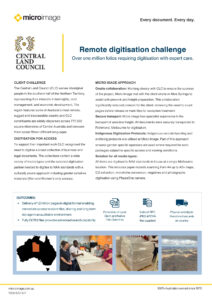
Many of the files we work with are located in rural and regional centres. The Central Land Council, located in Alice Springs/Mparntwe, works with Micro Image to digitise documents for their constituents who live in a region that features some of Australia’s most remote, rugged and inaccessible country – across 777,000 square kilometres of Central Australia!
Read more about the Central Land Council digitisation project below.
To discuss digitisation, information governance and digital document management projects, get in touch at info@microimage.com.au.

Would you like more information? Please enter your details and we will be in touch.

Micro Image acknowledges the traditional owners and custodians of Country throughout Australia and acknowledges their continuing connection to land, sea and community. We pay our respects to the people, their cultures and Elders past, present and emerging.
Content © Micro Image 2026. All rights reserved.
Website by Pixeld